
Misal Romano Espanol Pdf [patched] Jun 2026
El Misal Romano (en latín, Missale Romanum ) es el libro litúrgico que contiene todos los textos necesarios para la celebración de la Santa Misa a lo largo de todo el año. Incluye las oraciones (colectas, sobre las ofrendas, postcomunión), los prefacios, el canon romano (plegarias eucarísticas) y los rituales para las solemnidades, fiestas y memorias de los santos.
: Documents like the Missale Romanum that provide the legal and theological foundation for the current edition. misal romano espanol pdf
. This encourages both ministers and the congregation to sing the Mass texts more frequently, enhancing the solemnity of the liturgy. Structural Clarity: El Misal Romano (en latín, Missale Romanum )
El Misal Romano (en latín, Missale Romanum ) es el texto oficial que contiene todas las oraciones, lecturas y rúbricas (instrucciones en rojo) necesarias para la misa. Mientras que el original está escrito en latín, las conferencias episcopales de cada país publican traducciones aprobadas por la Santa Sede. Mientras que el original está escrito en latín,
where cross-referencing between languages is a daily necessity. Accessibility in Digital Form: Many users prefer the Edición de Estudio
En resumen, el Misal Romano en español es la columna vertebral de la liturgia hispana; su versión digital en PDF es un recurso valioso que, usado con respeto a los derechos de autor y la normativa litúrgica, enriquece la vida espiritual y la organización pastoral.
Muchas parroquias con recursos digitales envían por correo electrónico un "Boletín Litúrgico Semanal en PDF" que contiene las oraciones del misal para el domingo. Busque en Google: "[Nombre de su diócesis] misal dominical PDF" .
eFatigue gives you everything you need to perform state-of-the-art fatigue analysis over the web. Click here to learn more about eFatigue.
Misal Romano Espanol Pdf [patched] Jun 2026
Welds may be analyzed with any fatigue method, stress-life, strain-life or crack growth. Use of these methods is difficult because of the inherent uncertainties in a welded joint. For example, what is the local stress concentration factor for a weld where the local weld toe radius is not known? Similarly, what are the material properties of the heat affected zone where the crack will eventually nucleate. One way to overcome these limitations is to test welded joints rather than traditional material specimens and use this information for the safe design of a welded structure.
One of the most comprehensive sources for designing welded structures is the Brittish Standard Fatigue Design and Assessment of Steel Structures BS7608 : 1993. It provides standard SN curves for welds.
Weld Classifications
For purposes of evaluating fatigue, weld joints are divided into several classes. The classification of a weld joint depends on:
- the macroscopic geometry of the pieces welded,
- the direction of the cyclic stresses, and
- the location of the crack that leads to failure.
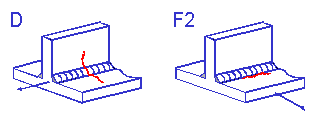
Two fillet welds are shown below. One is loaded parallel to the weld toe ( Class D ) and the other loaded perpendicular to the weld toe ( Class F2 ).
It is then assumed that any complex weld geometry can be described by one of the standard classifications.
Material Properties
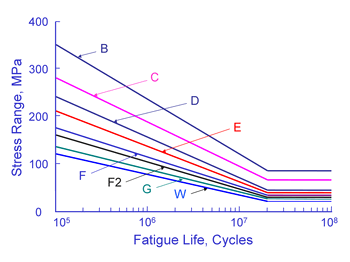
The curves shown above are valid for structural steel welds. Fatigue lives are not dependant on either the material or the applied mean stress. Welds are known to contain small cracks from the welding process. As a result, the majority of the fatigue life is spent in growing these small cracks. Fatigue lives are not dependant on material because all structural steels have about the same crack growth rate. The crack growth rate in aluminum is about ten times faster than steel and aluminum welds have much lower fatigue resistance. Welding produces residual stresses at or near the yield strength of the material. The as welded condition results in the worst possible residual or mean stress and an external mean stress will not increase the weld toe stresses because of plastic deformation. Fatigue lives are computed from a simple power function.

The constant C is the intercept at 1 cycle and is tabulated in the standard. This constant is much larger than the ultimate strength of the material.
The standard is only valid for fatigue lives in excess of 105 cycles and limits the stress to 80% of the yield strength. Experience has shown that the SN curves provide reasonable estimates for higher stress levels and shorter lives. In eFatigue, the maximum stress range permitted is limited by the ultimate strength of the material for all weld classes.
Design Criteria
Test data for welded members has considerable scatter as shown below for butt and fillet welds.
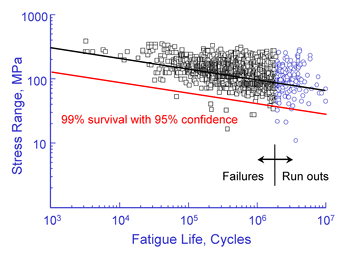
Some of this scatter is reduced with the classification system that accounts for differences between the various joint details. The standard give the standard deviation of the various weld classification SN curves.
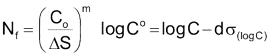
The design criteria d is used to determine the probability of failure and is the number of standard deviations away from the mean. For example d = 2 corresponds to a 2.3% probability of failure and d = 3 corresponds to a probability of failure of 0.14%.
© 2026 Amber Keystone